Opened in 1957 and closed in 1977, Eau Gallie Speedway left a lasting mark on Brevard County’s racing community and local memory.

ABOVE VIDEO: A look back at the now-abandoned Eau Gallie Speedway, which sat on 20 acres along the west side of Wickham Road. It opened in 1957 as “The Spinning Wheel Speedway,” and was also later known as Brevard Speedway, Eau Gallie Speedway, and Melbourne Speedway. (pittrow123 video)

On Wickham Road, the surviving curve of Eau Gallie Speedway tells a compact story about Brevard County’s growth: the Space Coast was looking toward rockets and new development, while a small dirt-and-asphalt oval gave local racers and families a place to gather. The track is gone as a venue, but its outline and the memories attached to it remain.
The 20-acre speedway opened in 1957 as The Spinning Wheel Speedway. Over the years it was also called Brevard Speedway, Eau Gallie Speedway and Melbourne Speedway, reflecting changes in ownership and local identity. Its final season ended in 1977; accounts point to October 29 as the date of its last program.
A local track with a short-track scale
Eau Gallie was built for close-up racing, not the sweep of a major superspeedway. The setting made the sport feel near at hand: spectators could hear cars warm up and watch the action from modest stands, while the pits and entrance were part of the same neighborhood scene. The attraction was as much the familiar Saturday routine as the competition itself.
That scale shaped the relationships around the track. Drivers, crews and spectators were likely to encounter one another again away from the oval, and local racers competed in front of people who knew them. The result was a venue where a night of racing could feel like a town gathering, with the same faces returning week after week.
Admission was reportedly $2 during the track’s active years. Under the lights, the program brought together people from different corners of the county, including welders, office workers, NASA technicians and service-industry employees. In a region changing quickly, the speedway offered a shared, accessible event rooted in local participation.
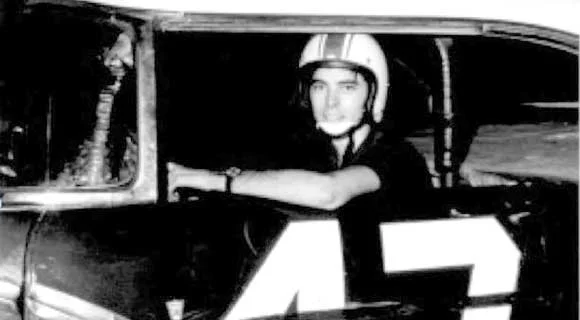
Bill Posey’s part in the speedway’s history
Bill Posey’s connection to Eau Gallie began as a racer seeking more laps. When opportunities were scarce, he took on a larger role: he helped operate the venue. In the late 1960s and early 1970s, Posey was an owner-promoter. He bought and renovated the track when it needed support, then handled the practical work of running race nights, from entries and payouts to the activity around the parts trailer.
His story captures the hands-on nature of local racing. A short track depended on people who could compete and keep the operation running, with the same community often filling both roles. Posey’s later public career made him a recognizable name, but his early work at the speedway tied him to the day-to-day effort that kept the racing program alive.
By the early 1970s, Eau Gallie had become part of Melbourne, but the oval continued to draw its identity from the racing itself: practice laps around dusk, main events under lights, and haulers heading out after the program. The schedule shifted with ownership and financial conditions, yet the track remained a fixture for roughly two decades.
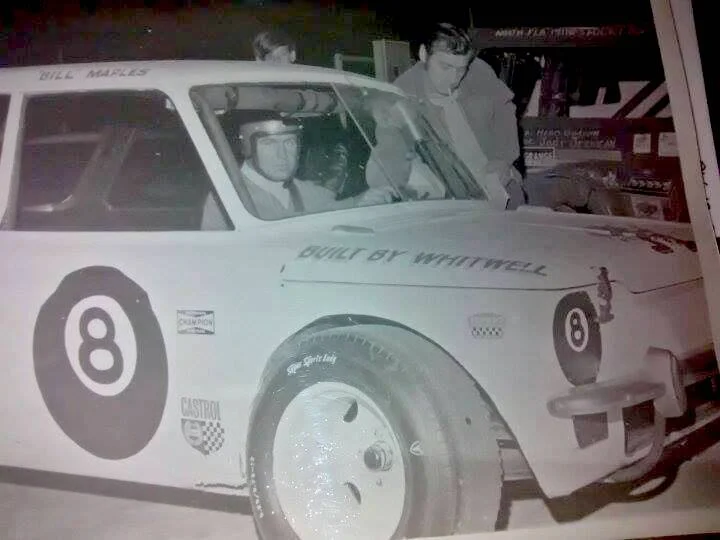
Why the track closed, and what remains
Small tracks operate with little margin, and Eau Gallie faced familiar pressures. Operating costs rose, development moved closer, and the value of the land increased. Those pressures eventually outweighed the business of running races. The last checkered flag fell in 1977, and the site entered the long afterlife common to closed venues: its physical use faded while its stories continued to circulate.
There are no grandstands or concession stands left to recreate a race night. Brush now covers much of the site, but aerial images and footage can still reveal the oval’s arc along the west side of Wickham Road. The remnant is modest. For people who remember the track, though, that curve is enough to locate it in the county’s past.
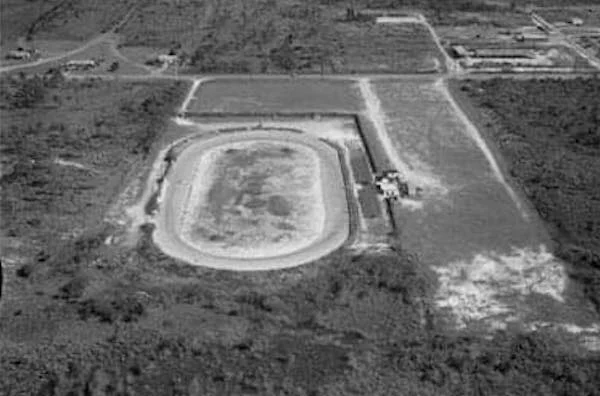
The speedway opened during a period of rapid change across the Space Coast, as ranch roads gave way to development and the region’s aerospace ambitions grew. Eau Gallie offered a different measure of progress: a local place where young drivers learned the craft, small sponsors could reach an audience, and families could spend a Saturday together. Its importance rested less on the buildings than on those repeated uses.
That history survives through conversation and shared material. Former racers can recall cars, turns and race nights; families pass along stories; and home movies and online videos give later generations a glimpse of the crowd and the track. A clip such as the one above serves as an informal record of a place with no conventional museum or preserved grandstand.
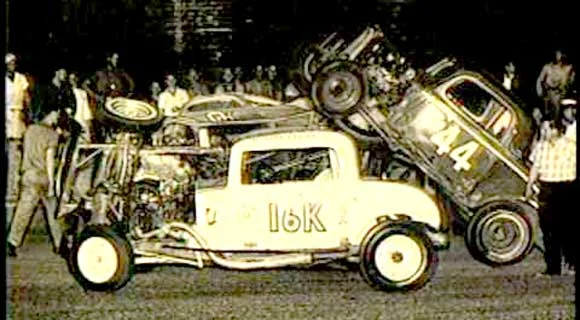
The site’s present condition makes the difference between a venue and its legacy easy to see. Pines and palmetto are reclaiming the ground, while the shape of the track can still be picked out by someone who knows where to look. The circle remains a point of reference for the people who raced, watched and worked there—and for those who encounter its history through photographs and video.
Eau Gallie Speedway’s two decades of racing left Brevard County with more than a closed track. The oval gave local drivers a place to build experience and brought neighbors together around a shared weekly event. As the physical site recedes into scrub, the footage and memories keep its place in the county’s history visible.

CLICK HERE FOR BREVARD COUNTY NEWS




Discussion
Sign in to join the discussion.