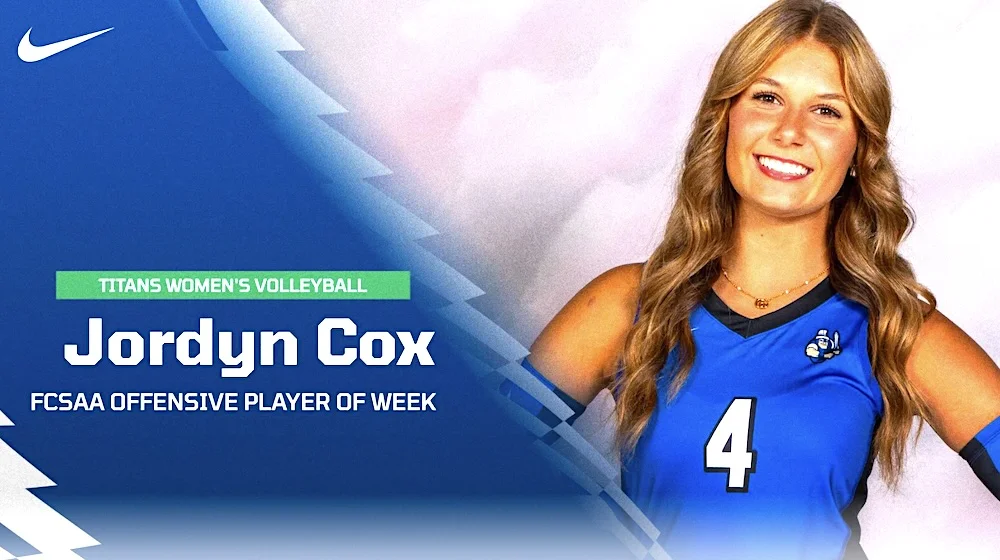
Eastern Florida State’s Jordyn Cox earned the weekly honor after a 30-kill finish to the regular season. The Titans host Polk State in Friday’s first round.
A late-season push earns Cox conference recognition
Jordyn Cox’s strong finish to the regular season earned the Eastern Florida State College sophomore the FCSAA Division I Offensive Player of the Week honor on Tuesday. She recorded 16 kills against Polk State College, then added 14 in a five-set win over Florida Southwestern. The award recognizes a run of production across two matches, with Cox contributing at the point of attack as the regular-season schedule reached its close.
In volleyball, a kill ends a rally with an attack the opponent can’t return successfully. The statistic is a direct measure of offensive results, though it doesn’t tell the whole story of a player’s contribution: a kill depends on the quality of the set, the timing of the attack, and the defense facing it. Still, producing 30 kills across these two matches gives a clear account of Cox’s impact in the stretch described.
The five-set result against Florida Southwestern also places her 14 kills in the context of a close match. Longer matches give teams more chances to score, but they also demand that players keep executing as the result remains unsettled. Cox’s total came in a win, a combination that makes the performance more meaningful than a stat line on its own.
What the numbers say about her season
Cox has 127 kills this season and is approaching 400 for her career. Those totals offer two different views of her contribution: the season figure tracks her current production, while the career figure reflects her accumulated work at Eastern Florida State. The source doesn’t provide a match count or a comparison with teammates, so the totals can’t establish a rate or a ranking. They do show that this late-season burst sits within a larger body of work.
That distinction matters when assessing a player’s role. A short run of high output can draw attention, but sustained contribution across a season is often what helps a team build consistency. Cox’s season total, paired with her recent results, suggests that her role has included both ongoing production and a particularly strong finish. The numbers here are encouraging; the available information simply doesn’t support a broader statistical comparison.
One final stretch can change how a season is remembered. Not by itself.
The seed and the next match
Cox’s late-season production helped the Titans secure the No. 3 seed. Eastern Florida State will host Polk State in an FCSAA Division I Championship first-round match Friday at 6 p.m. That gives the award a team context: the recognition follows performances during a period that coincided with the Titans securing a favorable place in the championship bracket, and the next match brings one of the same opponents back into view.
Polk State is a familiar opponent from the reported stretch, where Cox had 16 kills. That detail gives the first-round meeting a useful point of comparison, though it doesn’t predict how the match will unfold. A new game brings new rotations, adjustments, and pressure; the earlier total is evidence of what Cox produced in one meeting, not a guarantee of another similar performance.
For the Titans, a home first-round match means the postseason begins on their court. The source doesn’t describe the tournament format beyond this round or say what comes next for the winner. What it does establish is a clear immediate test: Eastern Florida State will face Polk State with a championship berth at stake, and Cox arrives after two productive matches.
Why the recognition carries weight
A weekly award is a snapshot, not a full evaluation of a season. It draws attention to a player’s recent results and gives readers a reason to look more closely at the team’s run-in. In Cox’s case, the recognition rests on specific production against two named opponents, including a five-set win, rather than on an isolated highlight. That’s a useful distinction for anyone trying to understand what the honor reflects.
And this is the part most people overlook: an offensive award can point toward the work that makes an attack possible as well as the player who finishes it. In a typical volleyball sequence, teammates have to keep the ball in play and create an opportunity for an attacker. The source doesn’t detail Cox’s sets or the team’s passing, so those contributions can’t be credited to particular players here. But the broader point remains: a kill is the visible end of a coordinated play.
This is more significant than it looks for a team entering the postseason. Individual recognition can mark a player’s form, while the seed and the first-round matchup frame what the group has to do next. Neither tells us the outcome in advance. They do establish that Cox’s production has been part of the Titans’ closing stretch, and that the next opportunity comes against Polk State again.
What to watch in the postseason
If you’re following Eastern Florida State, the clearest question is whether Cox can carry her recent attacking production into the first-round match. The figures to watch are already on the record: 16 kills against Polk State, 14 against Florida Southwestern, and 127 for the season. How those numbers translate into the championship match will depend on the play in front of her and the response from the opposing defense.
There’s no need to overread one award or two match totals. The team’s No. 3 seed gives the regular-season finish a concrete result, while Friday’s meeting offers the next measure of the Titans’ progress. Cox has supplied a strong ending to the regular season. Now the postseason begins.



Discussion
Sign in to join the discussion.